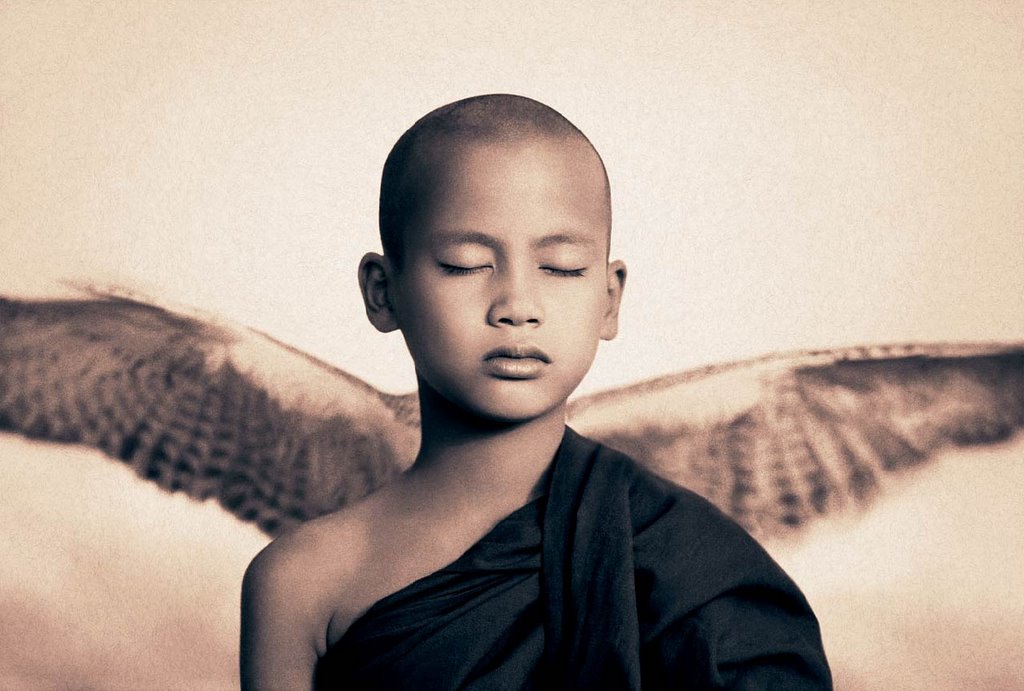
Do not go upon what has been acquired by repeated hearing; nor tradition; nor rumor; nor what is in a scripture; nor surmise; nor axiom; nor specious reasoning; nor bias towards one’s beliefs; nor upon another's seeming ability; nor upon the consideration, 'The monk is our teacher.' When you yourselves know: 'These things are good; these things are not blamable; these things are praised by the wise; undertaken and observed, these things lead to benefit and happiness,' enter on and abide in them.
Friday, 11 September 2015
Close to home.
Sunday, 21 September 2014
Anger
![]() |
| Illustration credited to Alex Hill |
Thursday, 8 December 2011
Transmigration – Rebirth Reconsidered
Friday, 4 March 2011
Book Review: Living as a River
That said, his recent book, “Living As a River: Finding Fearlessness in the Face of Change,” is a marvelous piece of work. It is, in essence, a call to reflection for each of us, to reflect on our lives and our potential, and to reflect on the fact that we too often (nearly always) squander that potential by seeking happiness in all the wrong places.
The book unfolds as an offering (dāna). What is offered is an alternative to our unhappiness, our mere fleeting happiness, and our chasing of ever more happiness. The alternative is framed around the Buddhist Six Element Practice. But as Bodhipaksa says, this is not “a ‘Buddhist book.’” While the traditional Buddhist Six Element Practice forms the spine of the book, the heart is as fresh and modern as the many psychology experiments and quantum physics theories you will read about in its pages. It consists of fifteen chapters, plus an introduction, filled with philosophy, mythology, science, poetry, and the author’s own experiences, all winding a common path toward the destruction of our habitual, and false, idea that we have an unchanging self.
In fact “Living Like a River” begins with a psychology experiement in which a professor asked subjects to imagine the death of their partner. The result? The subjects, “reported feeling more positive about their relationships and less troubled by their significant others’ annoying quirks.” This makes the point that, more often than not, the things that we think will make us happy, do not – and the things that we think might make us unhappy – or be simply morbid, like imagining death – can actually improve our lives.
For the Buddhist, this can be an obvious fact. Most philosophers as well, East and West, have noted that human suffering is rooted in our incorrect understanding of ourselves and the world. But these days, neither Buddhist teachings nor philosophy have managed to penetrate deeply into the Western psyche. That is why Bodhipaksa’s use of psychology and other sciences so important. Science, especially the natural sciences such as physics, chemistry, and biology (all discussed in the book), has a special place in the minds of educated Westeners as the major, if not final, arbiter of truth. So if science can “catch up,” so to speak, with these important truths of the Buddha and certain other philosophers, there’s a chance that the rest of us also might get it.
And so the book marches forth, beginning at times with a bit of poetry, a story from Bodhipaksa’s life, or an interesting fact from recent scientific research, all woven together around the key insights first elucidated by the Buddha, Siddhartha Gautama, some 2500 years ago. The purpose of the book isn’t to be “about Buddhism” as the quote mentioned above makes clear. It is about a way of thinking, a way of seeing clearly (or cultivating “insight” as the Buddhist meditation vipassanā is commonly translated) ourselves and the world. For all readers, it should be a joyful jorney through a hand-picked series of scientific articles and discoveries, poetry, and anecdotes. It is lucidly written, and even consistently funny (a nice change of pace for some of us!).
As I re-skim it now to write this, I find quote after quote and story after story that I’d love to recount for their simple and direct teaching power. But alas, I’ll spare you all of that and just suggest you get the book yourself. You’ll be glad you did. (available at Soundstrue or Amazon)
Cross-posted at American Buddhist Perspective.
Monday, 3 May 2010
Was the Buddha Guided by Evil?
Or "Don't kick the baby!"
I found myself very happily re-submerged in philosophy today thanks to the excellent and argumentative work of Charles Goodman's Consequences of Compassion
I think he's wrong, of course, because he's a consequentialist and thinks Buddhism is too. But more on that another time.
For now I want to switch topics and books a bit. Reading Goodman forces you to reexamine the foundations of ethical thinking (bravo!). So I cracked open another book, Deontology
In that chapter, Nagel presents us with a thought experiment. (paraphrased):
You and some chums are on a backroad in Montana at night (thus alone). You crash. Your friends are in bad shape. You run along the road until you reach the only house for miles. Inside is an old lady taking care of a child. You plea for help but she freaks out and locks herself in the bathroom, leaving you alone with the baby. There is no phone in the house (yea, that's Montana for ya), but there is a car outside that you could use to go get help. You just need the keys. You realize that you might get her to help you if you harm the baby (just a little) outside the bathroom door. Should you do it?You just need to cause the baby a little pain, enough to get him/her to cry, and in the end you'll be able to help your friends. To a consequentialist it seems to be a no-brainer. Of course you kick the baby (softly)! It's just a tiny bit of pain and your friends are relying on you - suffering much, much more. It's the right thing to do.
But the thing is, for most of us, there's just something wrong with that. There is an intuition that makes our gut turn a bit at the thought of harming an innocent person, even if it relieves much more pain for others. If that intuition is strong in you, you're likely to fall on the deontological side of the fence and say, "no, I'm not gonna kick the baby" even if it means further delay and suffering for your friends.
Darwall, earlier in the book, gives another experiment. We all generally agree that betraying our friends is wrong. A consequentialist might argue that this is because fidelity leads to a good society and happy people. A deontologist sees something intrinsic to the nature of friendship and honesty that in itself demands our fidelity. Darwall asks us to imagine a situation where you know two people will soon betray their best friends. Suppose that you know that if you betray your best friend, these two people will be so horrified that they won't go forward with their betrayals. Given the option, would you choose to betray your best friend?
The net effect if you act is fewer betrayals, so a consequentialist would urge you to betray your friend. (Note, there are as many flavors of consequentialism as Baskin Robbins has ice cream; I'm only dealing here with the bare-bones "the morally right thing to do is that which gets the best consequences" version.)
We could take it a notch further and suppose that you knew that your best friend actually was about to betray someone herself! So now you are to betray a friend who is about to betray someone else. Does that feel a bit better? Now we're not so much dealing with an "innocent" person. But for a deontologist this still doesn't seem right. We have a duty to fidelity based on our relationship to this person. We should not betray her even if that is the only way to avert multiple betrayals.
For Nagel, to betray our friend or kick the baby is to intentionally cause harm (evil), and in his words to "aim at evil, even as a means, is to have one's action guided by evil."
What do you think? And do you see where I'm going with this?
There is a key Mahāyāna text, the Upāya-kauśalya Sūtra, (see Tatz
Hold it there.
A consequentialist reading would not only fully agree with the Bodhisattva's reasoning here, but would find him fully justified in killing the robber. For a consequentialist, murdering the robber would be doing the right thing.
A deontologist would disagree. Murder is right at the top of the list of morality's no-no's. Even to murder a would-be murderer is still, well, murder. Now, just as there are many flavors of consequentialism that allow certain rules and whatnot into the system, a deontologist can just as well occasionally allow overriding circumstances in which doing the wrong thing may be necessary. Here is one such case. But it's still wrong; it is still, in Nagel's words, being "guided by evil."
Again, what do you think?
Well, the Buddha (to-be), out of "great compassion and skill in means," kills the robber.
And then? According to contemporary tellings of the story, he is born in hell - but only for a while. And the sūtra itself says that he steps on a thorn in his final life (as the Buddha) as a result of that past deed. The point in both is that he suffers the repercussions of having committed a wrongful deed. This suggests that Buddhism clearly isn't consequentialist. We can imagine a culture or religion in which the murder of the robber would have brought the Bodhissatva great glory, health, fame, and rebirths in heaven. It might take us a while, but I'm sure we can come up with some religion that says that killing a 'bad guy' is okay or praiseworthy...
But in Buddhism, even killing a bad guy is wrong. It may be necessary at times, but the karma's gonna get you. So we have in the tradition itself something of an admission that the Buddha (to-be) did something wrong, and faced the karmic results of it: a rebirth in hell and later getting a thorn in his foot.
Yes, the Buddha was guided by evil (to use Nagel's dramatic wording).
Going back to our first thought experiment, we might thus conclude that the Buddha would kick the baby if he knew this was the only way to get the keys and save his friends from the coyotes and badgers sure to be lurking along the back roads of Montana. And perhaps you should too. But it would still be wrong and there would still be moral (karmic) repercussions.
Monday, 2 November 2009
Self, No-self, Psychology and Buddhism
In the interview, Epstein says, roughly, that the self is real, it's just not really real. Tricycle editors picked up on that in their title:
The self exists, it’s just not as real as you think.
My response(s) follow, slightly edited.Hmmm… Is that like saying a creator God exists, it’s just not as real as you think? Sounds fishy. Perhaps skillful, but fishy nonetheless.I'm curious about the apparent streak of neo-Puggalavadins or Attavadins (those who teach that there is a person, or there is a self) in contemporary Buddhist circles. I suppose it has to do with our cultural fascination with the self: liberating it, actualizing it, helping it. If you're trying to gain self-liberation, self-actualization, or self-help you're probably off on a wild-goose chase. Much like trying to have a conversation with an omniscient, benevolent, creator God.Sabbe dhamma anatta, all phenomena are not-self. Even nibbana is anatta. And all of samsara is associated with the 5 khandhas, which are the basis for all other dhammas. Where then, lies the self in Buddhism? (hint, next to unicorns and the creator God).
On second thought, yes, the Buddha does make wide use of the term atta as a reflexive pronoun: “nowhere is found one who is dearer than [one]self; in this way for others too the self is dear. Thus one should not harm others who loves [him/her]self.” (Nevajjhagā piyataramattanā kvaci; Evaṃ piyo puthu attā paresaṃ, Tasmā na hiṃse paramattakāmo’’ti.) fom the Mallika sutta in SN I,3 (#8). But this should be read as making an ethical point rather than a metaphysical one: you [think] you have a self, and it is dear to you; this is also true of others, so develop metta/lovingkindness for all (as you do yourself).In this way the Buddha uses the term in a practical or conventional manner. When speaking of the true nature of things, though, the above quoted sabbe dhamma anatta, along with anatta as one of the “Marks of Existence” should suggest clearly his teaching of no-self. This is as much of a categorical denial as I can think of. He doesn’t deny the existence of the self to the wanderer Vacchagotta precisely because FOR HIM (this confused Brahmin) it would lead to a belief in annihilationism. So in that instance we have the Buddha’s silence. (SN 44:10)
As for the necessary fiction of self; yes it probably is needed at some level, but at the point of awakening we are said to finally(!) let go of the “asmi mana” the conceit or mania of I AM. I suppose as long as we have the conceit of self, it’s useful to act accordingly :)
Check out the Sabbasava sutta. There the Buddha lists 16 unwise reflections:
1. What am I?Now, as I mentioned in my first response above, any questioning into the self is thus pretty fishy. BUT, it could perhaps be skillful for some people. Just as in the Tevijja Sutta, where the Buddha tells young Brahmins that he'll teach them "the way to union with Brahma" and in fact teaches them ethics and meditation toward awakening, we perhaps could tell people we'll help them "discover their true self" only to lead them, through ethics and meditation, to the understanding of no-self. I'll leave you with one last snippit from the Pali sources (many thanks to Thanisarro Bhikkhu for compiling some Pali sources on Anatta):
2. How am I?
3. Am I?
4. Am I not?
5. Did I exist in the past?
6. Did I not exist in the past?
7. What was I in the past?
8. How was I in the past?
9. Having been what, did I become what in the past?
10. Shall I exist in future?
11. Shall I not exist in future?
12. What shall I be in future?
13. How shall I be in future?
14. Having been what, shall I become what in future?
15. Whence came this person?
16. Whither will he go?
“Monks, where there is a self, would there be (the thought), ‘belonging toTo say that this is a denial of only a certain kind of self seems to me to miss the point. It's like, to reiterate the above, saying that the Buddha only denied a certain kind of creator God, and thus perhaps there is one after all for Buddhists. Any view of self, it seems, is going to spiral into wasted time and effort trying to understand, fix, help, whatever, it (unless, again, guided by a wise teacher toward the understanding that there is no self). Similarly, views of God can be played with (as in the Tevijja sutta) by the wise, in order to bring others to an understanding of ethics, meditation, and wisdom (aka the Buddha's 3-fold path).
my self’?”
“Yes, lord.”
“Or, monks, where there is what belongs to self, would there be (the thought),
‘my self’?”
“Yes, lord.”
“Monks, where a self or what belongs to self are not pinned down as a truth
or reality, then the view-position—‘This cosmos is the self. After death this I will
be constant, permanent, eternal, not subject to change. I will stay just like that for
an eternity’—Isn’t it utterly & completely a fool’s teaching?” — MN 22
But in the hands of the unwise, people like me, speculation on the self or God is just likely to waste time.. how many gods can dance on the head of a pin? Oh, I'm sorry, that was angels. I'll have to speculate on that in a future post.
Saturday, 18 October 2008
The Hard Problem of Consciousness
One of the things that interested me about Buddhism is that it might give me some insights into such philosophical problems as the 'Hard problem of consciousness', which is also related to the mind-body problem.The really hard problem of consciousness is the problem of experience. When we think and perceive, there is a whir of information-processing, but there is also a subjective aspect. As Nagel (1974) has put it, there is something it is like to be a conscious organism. This subjective aspect is experience. When we see, for example, we experience visual sensations: the felt quality of redness, the experience of dark and light, the quality of depth in a visual field. Other experiences go along with perception in different modalities: the sound of a clarinet, the smell of mothballs. Then there are bodily sensations, from pains to orgasms; mental images that are conjured up internally; the felt quality of emotion, and the experience of a stream of conscious thought. What unites all of these states is that there is something it is like to be in them. All of them are states of experience.
David Chalmers
Of course, although Buddhism makes use of philosophical discourse, it is ultimately existential in nature and so we should expect any answers to be existential rather than purely intellectual in nature.
The Buddhist resolution of such problems is less of a process of intellectual progress as a matter of the 'ironing out' and collapsing of the roots of the issue which are ways of thinking about reality which ultimately are deluded.
And perhaps I am being premature or naive but the more I investigate, the more it really does seem that many contemporary problems were solved by Buddhist sages and thinkers in the distant past (although I see some Buddhist sages and thinkers mired in the same sort of thinking or even greater confusion). Given that philosophers in the west rarely learn anything other than the history of western philosophy, and that Buddhism is regarded (and practiced) generally as a religion, it isn't surprising that there isn't much cross-pollenation.
With regards to the above problem, it seems to me that it arises from the assumed reality of objective existence:
1 Ultimately reality is objectively real and independent of our experience of it
2 From experiential evidence I cannot deny my subjective experiences
3 Therefore they must be part of reality
4 If my subjectivity exists then other people's subjectivity probably exists
5 Therefore they must all be part of objective reality
6 So how can a subjective something really exist within (and arise from) an objective reality?
So we end up with a picture of all these creatures walking around an entirely physical universe, but with little subjective bubble-worlds in their heads (or above them or somewhere else or nowhere at all). How do these two worlds interact? If one arises from the other, how? How could subjectivity arise from objectivity ever, even in principle? And if subjectivity is an ineffectual epiphenomenon, why does it make a difference when I stop making an effort?
Rather than try to solve this set of problems with its assumed premises, we can observe reality carefully with as few assumptions as possible. In Zen abstract thought is seen not as truth but as a bodily function, which at best has a practical use. Thoughts exist as representations of reality, but are only ever representations with a greater or lesser usefulness. In fact many of the more bizarre responses from Zen masters to philosophical questions can be seen as expressions of 'unasking' questions which are based on deluded premises, for example 'Mu', 'Katz!', 'the oak tree in the garden' or the act of placing a sandal on the head.
I remember a story that my philosophy tutor told us about G.E.M. Anscombe, the student of the famous linguistic philosopher Ludwig Wittgenstein (who wrote extensively on the limits of language). During a conference of some sort, Anscombe was asked a question (how I wish I knew what that question was!) and she responded by removing her shoe in front of an international audience of philosophers and placed it on her head. Of course, without any grounding in eastern philosophy, most of the spectators (including my tutor) naturally assumed that she was batty. (Although Anscombe must have been elderly at this point, I have no reason to suppose that her mental faculties were failing. She was well-known for her intelligence and debating skills and famously won a debate against C.S. Lewis at Cambridge, forcing him to re-write a chapter of his book.) Anyone familiar with Zen stories will of course recognise this gesture as being identical to that performed by Joshu in response to a question from his master Nansen:
Once the monks of the eastern and western Zen halls were quarrelling about a cat. Nansen held up the cat and said, "You monks! If one of you can say a word [about ultimate truth], I will spare the cat. If you can't say anything, I will put it to the sword." No one could answer, so Nansen finally slew it. In the evening, when Joshu returned, Nansen told him what had happened. Joshu, thereupon, took off his sandals, put them on his head and walked off. Nansen said, "If you had been there, I could have spared the cat."
Source
The response might be seen as indicating that which is beyond language. Interestingly Wittgenstein himself famously declared that all philosophical problems had their roots in our use of language. He later retracted this having apparently found exceptions and tacked those in his Philosophical Investigations, which I really must read sometime.
If we think of our deluded belief-systems as a tree, which needs to be killed, then growing new branches to kill off other branches is no good - it just leads to proliferation of branches. Instead we can grow an axe to chop down the entire tree and then destroy itself - this is the project of Nagarjuna as I understand him. Alternatively we can stop watering the tree - in other words, release the attachments or delusions that feed it.
Many Buddhists (especially the ones I come across online) seem to see Buddhism as being 'against' rationality - often replacing it with some sort of intuitionism. I think this is a misunderstanding. Buddhism isn't against thinking - we need abstract thought in our lives to help achieve practical goals; there are many influential Buddhist philosophers who used rationality as part of their practice (eg. Nagarjuna). The goal is not the cessation of thinking, rather the goal is freedom from attachments to thoughts, feelings, and so on. Thoughts exist and they are sometimes useful, but they are only ever thoughts - and the conceptual reality they tempt us to enter is a virtual reality.
In Buddhism, experiencing reality without inherent dualities and seeing those dualities as inputted is the important thing. But explaining things in such a way that they might shed light on complex rational problems still takes a whole lot of conceptualisation and a whole lot of words. Hopefully I'm up to the task and hopefully I'm not just throwing more wood on the fire.
Coming back to the Hard Problem of Consciousness, what I see is that the premise of the existence of absolute objective reality is unsound. If I pay attention, I can see that I never actually come across this supposed objective reality, only ever the idea of it. Yet I'm not proposing that we replace this with some sort of philosophical Idealism. If I hide an object, forget about it and then come back to it, it's still there. Things I know nothing of still have causal effects in the universe and (in the case of sense perceptions and psychoactive drugs) can influence the nature of mental phenomena in my mind. I can't change reality just by thinking about it.
While there are entities which outside of my awareness, that does not mean that they are independent of me or that I am independent of them. And if there is an independent objective universe, it is independent and thus not part of all this.
Materialism asserts that reality consists entirely of 'non-self' and is entirely independent of me and Idealism asserts that reality consists entirely of 'self' and is partly or fully dependent on me. But by claiming the universality of one domain or the other 'self' or 'non-self' neither damages self/non-self dualism, it just tries to squeeze the border off the map. This is doomed because 'self' and 'non-self' are interdependent concepts. How can a subject exist without an object to perceive? How can objective reality be real with no subject to ever know of or be influenced by its existence? What meaning does non-self have without the existence of a self? How much do we have to distort non-self to include the phenomena we now label as 'self'? And vice-versa.
Both Materialism and Idealism are only partial, distorted truths - attempts to unify reality without dispatching or deconstructing subject-object duality.
So what is the relationship between subject and object? The Buddhist view and a view which can be experienced in meditation, is that the distinction is inputted by thought. All phenomena are interdependent. The 'objective world' is just reality existing from the 'point of view' of another aspect of the same reality - the 'objects' of perception are just causative effects 'acting through' the other causative effects that are my sensory apparatus and my brain in an immense interdependent web without ultimate objects. Causality does not just flow 'upwards' from object to subject, but in every direction without end. My mind is just this moment of reality.
Reality is dependent upon observation. It has no 'Gods eye view' from which it exists. Nothing real is standing outside of reality to see it. It can only be viewed from inside and it only 'exists' in relation to other parts of itself. Even the description of reality as a set of relationships is not something that exists objectively, that image is just an abstraction, it exists always from a point of view - in relation to my reality at the time of writing and to your reality right now. But what is a point of view? A point of view is an abstraction - a model built from interpretation of effects of one part of reality upon another. A point of view of a landscape is just the sum of all the effects of each aspect of that situation upon a smaller part of that situation e.g.. all the light from a landscape as it affects a camera and an eye and a brain/mind.
What unites all of these states is that there is something it is like to be in them. All of them are states of experience.
What does 'something it is like to be in them' mean? The word 'like' in this context is a term of comparison. In what way (if any) is being in a subjective state similar to something? It isn't so much that it is similar to something, but that it is something - it's real. This statement also presupposes the existence of a continuous identity which is 'in' various states. What if (as most current research on consciousness suggests) there is no 'Cartesian Theatre', no container for such states to exist in? nor a homunculus, an inner witness for these states? If only the states themselves and their effects exist then is there any philosophical problem?
All states - even the state of an unwatched beaker of water in an empty building - are part of the causal matrix of reality (see The Butterfly Effect, Chaos Theory). Whether there are faculties to interpret these effects as information or not, no black box exists from which effects cannot spill so effects ripple out across the universe at the speed of light and we are all affected - it is 'like something to be in' every state. A problem arises only if we conceptualise reality in terms of categories which are independent of one another. For it to be 'like something to be in' a state is just to be contiguous with that state, to be affected by that state and (given that there can be no independent objects) ultimately to be that state.
My acts are irrevocable
Because they have no essence...
Where are the doers of deeds
Absent among their conditions?
Imagine a magician
Who creates a creature
Who creates other creatures.
Acts I perform are creatures
Who create others.
Nagarjuna