Wednesday, 29 October 2008

Death of a Friend

Yesterday, I was told a friend of mine Sean, who I had worked with for over a year was struck and killed by an automobile on Saturday. I didn't know Sean as a close personal friend, but I saw him almost every workday over the past year. Normally I wouldn't post something like this, that doesn't have much to do with Buddhism, however something about the way Sean lived his life has touched everyone he met.

Sean was one of those people you meet that simply just grabbed your attention and you became instantly comfortable around. He always smiled, big bright smile, to everyone weather he was feeling poorly or not. He had a kindness and compassion about him that just drew friends to him like leaves sprouting from a tree in spring. It is not possible to over exaggerate what a kind sociable, warm person he was, willing to help anyone, treated everyone in the same gentle peace loving manner.

The most wonderful thing about it was he didn't see himself as this kind of great human being. Being only 19 years old, he exuded life and happiness, beyond his own desire to see himself in this light. I think if we all found the peace and happiness he had, our world would be a much kinder place. It is such a horrible, cruel turn of life. How can one comfort all those that were touched by him, affected by his dedication of goodwill?

A friend of mine, who was also a friend of Sean's who knew I was a Buddhist, asked me how Buddhists can explain why life is so cruel to people who are so good. I was stumped. I thought for a few moments and then I talked about the reason things in life are so precious to us is that they are fleeting and impermanent. I mumbled something about everything changes and nothing lasts forever. I realized, that though these things may be true, it doesn't help those grieving find some measure of peace.

Only an old Dr.Seuss quote popped into my mind:
"Don't cry because it's over. Smile because it happened."

Rest in peace my brother, your life on earth made a difference to everyone around you.

Edit: Here is a picture of Sean and a link to his obit.
http://www.legacy.com/washingtonpost/DeathNotices.asp?Page=LifeStory&PersonID=119553879

Wednesday, 22 October 2008

What do you do here?

There was a young database administrator that won a good job at a mid size shoe manufacturing company. On his first day, excited, the young tech sat at his desk and immediately began working. Towards the middle of the day, an older gentleman, the owner of the shoe manufacturing company, walked up the new database technician, introduced himself and asked the young man "What do you do here?" The young tech smiled and said "I am a database administrator" and then continued typing away. The owner asked again, this time with a little harshness in his voice, "What do you do here?" Puzzled, the young tech once again repeated "I am the database administrator. I build and maintain the company's database." The owner, now with a forceful, almost angered pitch asked "What do you do here?" The young tech, now flustered, answered, "I am a database administrator! I....I'm sorry....I don't know what you are looking for me to say!"

The owner curtly said "If you don't say you make shoes then the door is over there!"


What do you do here?


Perhaps we can meditate on this question for a bit.

Saturday, 18 October 2008

The Hard Problem of Consciousness

One of the things that interested me about Buddhism is that it might give me some insights into such philosophical problems as the 'Hard problem of consciousness', which is also related to the mind-body problem.

The really hard problem of consciousness is the problem of experience. When we think and perceive, there is a whir of information-processing, but there is also a subjective aspect. As Nagel (1974) has put it, there is something it is like to be a conscious organism. This subjective aspect is experience. When we see, for example, we experience visual sensations: the felt quality of redness, the experience of dark and light, the quality of depth in a visual field. Other experiences go along with perception in different modalities: the sound of a clarinet, the smell of mothballs. Then there are bodily sensations, from pains to orgasms; mental images that are conjured up internally; the felt quality of emotion, and the experience of a stream of conscious thought. What unites all of these states is that there is something it is like to be in them. All of them are states of experience.

David Chalmers

Of course, although Buddhism makes use of philosophical discourse, it is ultimately existential in nature and so we should expect any answers to be existential rather than purely intellectual in nature.

The Buddhist resolution of such problems is less of a process of intellectual progress as a matter of the 'ironing out' and collapsing of the roots of the issue which are ways of thinking about reality which ultimately are deluded.

And perhaps I am being premature or naive but the more I investigate, the more it really does seem that many contemporary problems were solved by Buddhist sages and thinkers in the distant past (although I see some Buddhist sages and thinkers mired in the same sort of thinking or even greater confusion). Given that philosophers in the west rarely learn anything other than the history of western philosophy, and that Buddhism is regarded (and practiced) generally as a religion, it isn't surprising that there isn't much cross-pollenation.

With regards to the above problem, it seems to me that it arises from the assumed reality of objective existence:

1 Ultimately reality is objectively real and independent of our experience of it
2 From experiential evidence I cannot deny my subjective experiences
3 Therefore they must be part of reality
4 If my subjectivity exists then other people's subjectivity probably exists
5 Therefore they must all be part of objective reality
6 So how can a subjective something really exist within (and arise from) an objective reality?

So we end up with a picture of all these creatures walking around an entirely physical universe, but with little subjective bubble-worlds in their heads (or above them or somewhere else or nowhere at all). How do these two worlds interact? If one arises from the other, how? How could subjectivity arise from objectivity ever, even in principle? And if subjectivity is an ineffectual epiphenomenon, why does it make a difference when I stop making an effort?

Rather than try to solve this set of problems with its assumed premises, we can observe reality carefully with as few assumptions as possible. In Zen abstract thought is seen not as truth but as a bodily function, which at best has a practical use. Thoughts exist as representations of reality, but are only ever representations with a greater or lesser usefulness. In fact many of the more bizarre responses from Zen masters to philosophical questions can be seen as expressions of 'unasking' questions which are based on deluded premises, for example 'Mu', 'Katz!', 'the oak tree in the garden' or the act of placing a sandal on the head.

I remember a story that my philosophy tutor told us about G.E.M. Anscombe, the student of the famous linguistic philosopher Ludwig Wittgenstein (who wrote extensively on the limits of language). During a conference of some sort, Anscombe was asked a question (how I wish I knew what that question was!) and she responded by removing her shoe in front of an international audience of philosophers and placed it on her head. Of course, without any grounding in eastern philosophy, most of the spectators (including my tutor) naturally assumed that she was batty. (Although Anscombe must have been elderly at this point, I have no reason to suppose that her mental faculties were failing. She was well-known for her intelligence and debating skills and famously won a debate against C.S. Lewis at Cambridge, forcing him to re-write a chapter of his book.) Anyone familiar with Zen stories will of course recognise this gesture as being identical to that performed by Joshu in response to a question from his master Nansen:

Once the monks of the eastern and western Zen halls were quarrelling about a cat. Nansen held up the cat and said, "You monks! If one of you can say a word [about ultimate truth], I will spare the cat. If you can't say anything, I will put it to the sword." No one could answer, so Nansen finally slew it. In the evening, when Joshu returned, Nansen told him what had happened. Joshu, thereupon, took off his sandals, put them on his head and walked off. Nansen said, "If you had been there, I could have spared the cat."

Source

The response might be seen as indicating that which is beyond language. Interestingly Wittgenstein himself famously declared that all philosophical problems had their roots in our use of language. He later retracted this having apparently found exceptions and tacked those in his Philosophical Investigations, which I really must read sometime.

If we think of our deluded belief-systems as a tree, which needs to be killed, then growing new branches to kill off other branches is no good - it just leads to proliferation of branches. Instead we can grow an axe to chop down the entire tree and then destroy itself - this is the project of Nagarjuna as I understand him. Alternatively we can stop watering the tree - in other words, release the attachments or delusions that feed it.

Many Buddhists (especially the ones I come across online) seem to see Buddhism as being 'against' rationality - often replacing it with some sort of intuitionism. I think this is a misunderstanding. Buddhism isn't against thinking - we need abstract thought in our lives to help achieve practical goals; there are many influential Buddhist philosophers who used rationality as part of their practice (eg. Nagarjuna). The goal is not the cessation of thinking, rather the goal is freedom from attachments to thoughts, feelings, and so on. Thoughts exist and they are sometimes useful, but they are only ever thoughts - and the conceptual reality they tempt us to enter is a virtual reality.

In Buddhism, experiencing reality without inherent dualities and seeing those dualities as inputted is the important thing. But explaining things in such a way that they might shed light on complex rational problems still takes a whole lot of conceptualisation and a whole lot of words. Hopefully I'm up to the task and hopefully I'm not just throwing more wood on the fire.

Coming back to the Hard Problem of Consciousness, what I see is that the premise of the existence of absolute objective reality is unsound. If I pay attention, I can see that I never actually come across this supposed objective reality, only ever the idea of it. Yet I'm not proposing that we replace this with some sort of philosophical Idealism. If I hide an object, forget about it and then come back to it, it's still there. Things I know nothing of still have causal effects in the universe and (in the case of sense perceptions and psychoactive drugs) can influence the nature of mental phenomena in my mind. I can't change reality just by thinking about it.

While there are entities which outside of my awareness, that does not mean that they are independent of me or that I am independent of them. And if there is an independent objective universe, it is independent and thus not part of all this.

Materialism asserts that reality consists entirely of 'non-self' and is entirely independent of me and Idealism asserts that reality consists entirely of 'self' and is partly or fully dependent on me. But by claiming the universality of one domain or the other 'self' or 'non-self' neither damages self/non-self dualism, it just tries to squeeze the border off the map. This is doomed because 'self' and 'non-self' are interdependent concepts. How can a subject exist without an object to perceive? How can objective reality be real with no subject to ever know of or be influenced by its existence? What meaning does non-self have without the existence of a self? How much do we have to distort non-self to include the phenomena we now label as 'self'? And vice-versa.

Both Materialism and Idealism are only partial, distorted truths - attempts to unify reality without dispatching or deconstructing subject-object duality.

So what is the relationship between subject and object? The Buddhist view and a view which can be experienced in meditation, is that the distinction is inputted by thought. All phenomena are interdependent. The 'objective world' is just reality existing from the 'point of view' of another aspect of the same reality - the 'objects' of perception are just causative effects 'acting through' the other causative effects that are my sensory apparatus and my brain in an immense interdependent web without ultimate objects. Causality does not just flow 'upwards' from object to subject, but in every direction without end. My mind is just this moment of reality.

Reality is dependent upon observation. It has no 'Gods eye view' from which it exists. Nothing real is standing outside of reality to see it. It can only be viewed from inside and it only 'exists' in relation to other parts of itself. Even the description of reality as a set of relationships is not something that exists objectively, that image is just an abstraction, it exists always from a point of view - in relation to my reality at the time of writing and to your reality right now. But what is a point of view? A point of view is an abstraction - a model built from interpretation of effects of one part of reality upon another. A point of view of a landscape is just the sum of all the effects of each aspect of that situation upon a smaller part of that situation e.g.. all the light from a landscape as it affects a camera and an eye and a brain/mind.

What unites all of these states is that there is something it is like to be in them. All of them are states of experience.


What does 'something it is like to be in them' mean? The word 'like' in this context is a term of comparison. In what way (if any) is being in a subjective state similar to something? It isn't so much that it is similar to something, but that it is something - it's real. This statement also presupposes the existence of a continuous identity which is 'in' various states. What if (as most current research on consciousness suggests) there is no 'Cartesian Theatre', no container for such states to exist in? nor a homunculus, an inner witness for these states? If only the states themselves and their effects exist then is there any philosophical problem?

All states - even the state of an unwatched beaker of water in an empty building - are part of the causal matrix of reality (see The Butterfly Effect, Chaos Theory). Whether there are faculties to interpret these effects as information or not, no black box exists from which effects cannot spill so effects ripple out across the universe at the speed of light and we are all affected - it is 'like something to be in' every state. A problem arises only if we conceptualise reality in terms of categories which are independent of one another. For it to be 'like something to be in' a state is just to be contiguous with that state, to be affected by that state and (given that there can be no independent objects) ultimately to be that state.

My acts are irrevocable
Because they have no essence...
Where are the doers of deeds
Absent among their conditions?
Imagine a magician
Who creates a creature
Who creates other creatures.
Acts I perform are creatures
Who create others.

Nagarjuna

Originally published in my personal blog in 2006.
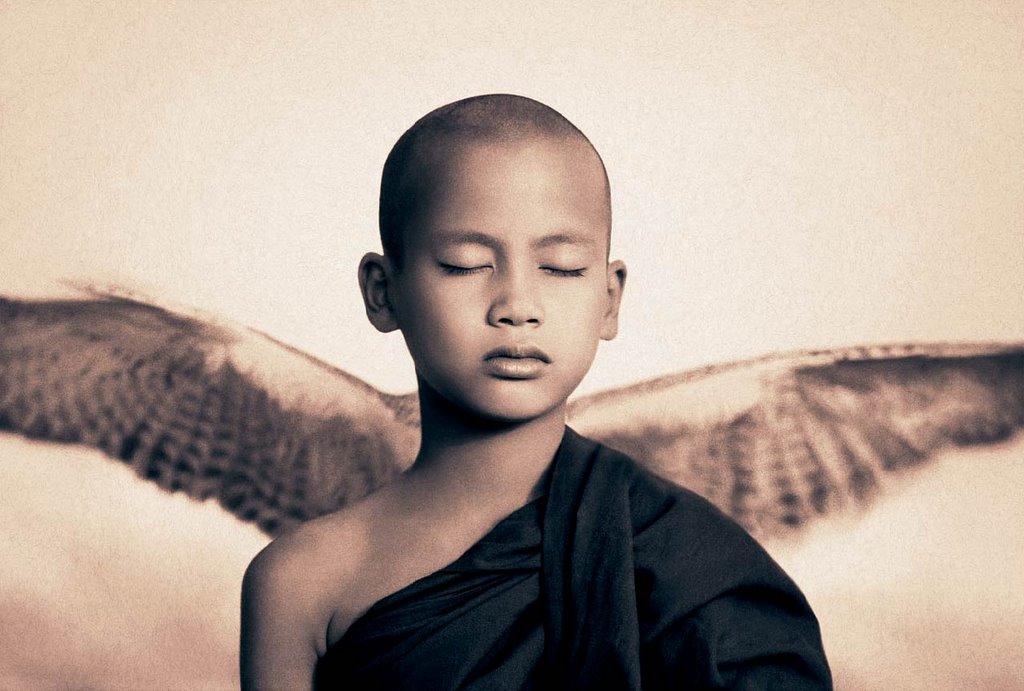
Photo by Gregory Colbert

Friday, 17 October 2008

Fear, Mental Illness and Meditation: The Importance of a Teacher

I have heard so many different misguided opinions about how Buddhism is 'dangerous' and can cause 'psychosis' and even 'permanent mental illness'. I have heard leaders and the priestly class of other religions say this, I have heard psychiatrists say this and even some historians. They claim that the Kamikaze pilots in World War Two shows how twisted Buddhism can make one become. Some Psychiatrists will point to patients having psychotic breaks sometimes needing hospitalization and even having permanent mental issues caused by practicing some form of Buddhist meditation. This is definitely some scary shit! But of course this is mostly hearsay and horseshit. ('They' do talk a lot, don't they?) But why would people say this and is there any grain of truth to it?


My answer may shock you, but yes, I see that in some ways, practicing some forms of Buddhist meditation without some understanding of what you are going to experience and if you have a pre-existing mental condition with no teacher to guide you can create feelings of great emotional stress and extreme anxiety. Saying that, I want to quickly say, this is only a tiny portion of those that attempt it and many people with mental disorders have found great relief from practicing Buddhist meditation. Obviously, much of what the first paragraph says is fear mongering, religious bigotry and just folks who have a enormous misunderstanding of our Buddhist practice.

I have experienced great fear while sitting in ZaZen a few times, and to be honest I was scared shitless. After you practice for awhile, some may start to see the realization of the emptiness of self and see some smatterings of unbridled reality. If one is unprepared for such an experience, feelings of great anxiety and fear can suddenly swell up, and this is perfectly normal and common. I think for the vast majority of practitioners this does not pose a great problem. However, the impact of realizing the emptiness of self, ego and identity should not be underestimated. When one begins to realize all that he or she took as self, identity and reality is stripped naked of the minds conceptions, not only can it become a life changing, beautiful event but it can also shake one to the their crumbling foundation.

In Zen, it is said that one must pass away before the attainment of enlightenment. They don't mean to actually die, but the idea or notion of self or ego dies. I think this is just as significant as death itself though. I realize this can be confusing. Perhaps this may help a bit:

If you think why we have difficulty in our life you will understand how to accept the difficulty. Before you are, you do not realize that we are one piece of water or one piece of universe. You have fear. You have difficulty because you have feeling. You attach to the feeling you have just now without knowing just how this kind of feeling is created.

So to dip the water from the river is to feel the water, the value of each individual, the value of the person who uses the water. At the same time when we become aware of individual feelings we have the feeling of the value of the water. So we…because of this feeling we cannot use the water just materially. It is living being. Originally it was with the big river. So if the water becomes one with the big river, the water will not have any feeling to it. It will resume to its own nature. By resuming to its own nature they have composure, they will be very glad to come back to original water. If so, when you die what feeling will you have? I think it is like water. We are like water in the dipper.

So if someone takes us to the original river the dipper…the water in the dipper will be very glad. So if we come back to original home we will be very glad. We will have composure there. Perfect composure. It may be too perfect for us just now. Now we have some….because we are so attached to the individual existence like this so we have attachment. For us, just now, in this way we have some feeling of fear or fear of death but after we resume to our true nature there is nirvana. That is why we say to attain nirvana when we die. It is same word. We say ‘to take nirvana’ is to pass away…to pass away is not so adequate expression. ‘To pass on’.

~Shunryu Suzuki, Zen Mind, Beginner Mind


We are dualistic, so what about the good stuff? When we seek truth with an honest motive, I think, although there may be some genuine difficulty, the realizations and understandings we have can transform our life or more importantly our mind's view of life to be more in sync with reality. We see people everyday, from every walk of life show great benefit from practicing earnestly, with a keen mind and right understanding. Today even many psychotherapists have adopted some Buddhist techniques of mindfulness and concentration in tandem with a cognitive therapy treating all sorts of different types of patients. My Zen Master once said that the appearance of fear is an encouraging sign of a students progression in practice. Weather it be Vipassanā, or ZaZen or some form of Tibetan Tantric practice, I think these forms of right concentration must be investigated or perfected in conjunction with right understanding, intention, mindfulness and effort. Perhaps, think about it like building a bridge across a river with no planks to walk on.


The ironic thing about this is the eventual appearance of fearlessness and composure. Once one begins to see beyond the shadow of self, then fear will begin to fade from the mind like a wave gently rolling back into the ocean. While I think it is more than possible for one to progress their practice by themselves, perhaps even to the attainment of enlightenment itself, most of us are in need of a teacher to see improvement. They can guide us, be our lifeline, show us where we fall and encourage us when we despair. I can not stress enough how much great wisdom and substance a good teacher can bring to us, to ease some of our worries and to explain some of our own fears. If you have the ability, I encourage you to find a teacher/monk/master, one that suits you and your choice of practice. Learn from others online or around you about the men and woman out there that do offer instruction, guidance and discipline, and make an informed decision.

So, is Buddhism dangerous? Perhaps, to a few, under certain conditions with no guidance or understanding. More importantly however, the thrust and tradition of Buddhism can mean the ultimate extermination of fear. Everything we do in life can be dangerous, getting out of bed, crossing the street or taking a shower can be dangerous. I believe our greatest danger we have, however, is not to reflect upon ourselves. Fearlessness is that perfect diamond embedded inside the boulder of fear.


"The only reason we don't open our hearts and minds to other people is that they trigger confusion in us that we don't feel brave enough or sane enough to deal with. To the degree that we look clearly and compassionately at ourselves, we feel confident and fearless about looking into someone else's eyes."
~Pema Chodron

Tuesday, 14 October 2008

Mornings are Difficult

Before I go off on my humorless rant here, I have to post this video cpd pointed me to yesterday. I Love Bill Murray and the movie Caddyshack, and its one of my favorite scenes ever. Thanks Cpd!


It isn't exactly what you would think of when you try to visualize a Buddhist. Broad shoulders, white, worn jeans, goatee, hockey jersey or t-shirt working on back room servers and databases. I think many of us are like this, this feeling of being some unusual people walking in our society, quiet and calm, our ways and practice under the surface known to just a select few. On my desk, the only things that I have that would insinuate I am a Buddhist is a small golden Buddha statue and a Spongebob doll. Hey, don't knock Spongebob, he is wise indeed, happiness is his path!! :)

Mornings I wake up, and I many times feel like I don't want to go out in the world, I don't want to watch the mindless selfishness of others, and keep quiet and contained. I don't want to do many things I feel are just ignorant to be complacent in some humanly duty owned to those we interact with, feel dispassion for. I don't like waking up, I dislike the morning TV shows spewing mindless drivel, lies for truth, smiles to cover a real and obscene hate. I don't feel like getting up, and doing it again, all over again, each morning feels like such a task.

Then a memory of a nice lady, walking past my desk the day before, stops to mention how nice a person she thought I was, always seeming to be kind and considerate. It is this, that reminds me that I am the judgmental one, the one wanting others to be like me. I am the one that wants others to be kind and considerate to everyone. It is me that is selfish and filled with my own desires and conceptions. It is my dislikes and anger that become so apparent, and I feel humbled and a bit shamed. It renews me to get up, and keep going, and keep my effort focused.

Perhaps one morning soon, I can awaken without acting on my discontent and opinions, not seeing my emotions grab hold of these thoughts and aimlessly run wild. Just maybe, one day, I can watch the compassion and dispassion of all beings come and go, unattached, and feel kindness towards them all. Until then, I'll keep getting up and keep my effort up and keep going. I am nothing special. It is all other beings that are special, and I should act accordingly.

Christ, I can be so emo sometimes.

Groundhog Day, Samsara and Salt

One of my favorite movies of all time, even before I fell into Buddhism was the 1993 movie Groundhog Day staring Bill Murray. It didn't take long before me and all my friends were quoting lines from the movie, and even to this day if I meet someone named Phil, I have to say in a long whiny voice "PHIL? Phillllllll Connors?" I think even besides the fact the movie was incredibly hilarious, it has some unspoken message about it that speaks to the truth of our human condition.

Today, some Buddhist's point to this movie as an example of Samsara, and some temples even have screenings every February 2nd. But what is Samsara and what does Groundhog Day have to do with it? Samsara has been translated into a few different types of meanings in the Buddhist tradition, depending greatly on who you hear it from. However, loosely speaking, Samsara is this wheel of life we are on, these ups and down and endless cycles and perhaps we can even say it stands in opposition of Nirvana.


Some would link it to the idea of rebirth or reincarnation and some tie it into Karma and the laws of cause and effect. For this post purpose, I'd like to show it in a more broad term and how the character of Phil Connors (Bill Murray) cycled endlessly through different scenarios each to day to try to figure a way out of his predicament. To speed this along, (spoiler alert) here is a decent synopsis from Wikipedia.

Self-centered TV meteorologist Phil Connors, his producer Rita, and cameraman Larry from the fictional Pittsburgh television station WPBH-TV9 travel to Punxsutawney, Pennsylvania to cover the annual Groundhog Day festivities with Punxsutawney Phil for the station. Phil, who has grown tired of this assignment, grudgingly gives his report and attempts to return back to Pittsburgh when a blizzard that he predicted would miss the area has shut down the main roads, forcing Phil and his team to stay in town an extra day.

Phil wakes up to find that he is reliving February 2 again; everyone else is repeating the same actions as from what he saw the day before, seemingly unaware of the time loop, though Phil remains aware of the events of the previous day. At first he is confused, but when the loop continues, he starts to try to take advantage of the situation without fear of long-term consequences, learning secrets from the town's residents, seducing women, stealing money, and driving drunk. However, attempts to get closer to Rita are repeatedly shut down. With each passage of the loop, Phil becomes despondent; during one loop, he kidnaps Punxsutawney Phil and after a long police chase, drives over a cliff, appearing to kill both Phil and the groundhog. However, Phil wakes up in the next loop and finds that nothing has changed; further attempts at suicide are just as fruitless as he continues to find himself back at the start of February 2.

Phil continues to try to learn more about Rita, and when he reveals his situation to her and the knowledge he's gained about the town's residents, she opens up to him and suggests he try to use his situation to help benefit the town. Phil uses her advice and the time loop to help as many people around town as possible, as well as bettering himself such as by learning to play jazz piano and speaking French. Phil, now engrossed with the town's celebration, is able to admit his love to Rita, and she accepts and returns her love. After the evening dance, the two retire together to Phil's room.

Phil wakes up the next day, and finds the time loop has broken; it is now February 3 and Rita is still in bed with him. As the team prepare to return to Pittsburgh, Phil and Rita talk about eventually settling down in Punxsutawney, but they'll "rent first."

No matter what we do, we are always here, always now. Sometimes we don't want to be here anymore and sometimes we fear losing what we have and cling onto things. Phil realizes even in a world without earthly consequences, our happiness we gain by doing all the things we ever wanted doesn't last. He also see's that no matter how hard he trys to not be here, to get away, he can't. It's this series of our high high's and low low's that we cycle through in our own lives. The happiness never lasts nor all the things we love, nor the sadness we experience or the things we hate. We try and try and try to either cling to those things we love or we try avoid those things we hate.

If we just watch however, this attachment to these events and objects may remain, but all things change; and what we love changes to hate and hate changes to love. This Samsara, this ride of life can't really be controlled in the manner of attachment, but our realization of this yearning can be distinguished. Phil realizes he is here, and there is nothing he can do about it. He eventually learns to truly care for the people he crosses path with and desires happiness for all the citizens of the town. He ultimately understands that he can find a sort of humble, satisfying happiness by just entering each day with an open mind and open heart. In the end, he shows a great selflessness, wakes up, gets the girl and the loop ends.

Our lives aren't like this Hollywood ending usually. However, we can learn to slowly get off this cycle, this wheel of attachment, this Samsara. I think with right concentration, understanding, effort and mindfulness we can begin to watch and see this world unfold, unattached to the specific up's and down's. Maybe a sort of divine acceptance and awareness?

As for reincarnation, even though this post has not a lot to do about it, I wanted to throw out this reflection. Perhaps, this rebirth, this endlessness is really that in each moment we have a chance to wake up, to be aware. Each moment, this object of mind, time, is a relative measure of us staying on this wheel of Samsara. Each moment we can wake up, be present, unattached, or in each moment we are reborn in a new thought, a new delusion. I'm probably way off base here and more than likely was a slug in my past life because I really, really detest salt.


"I was in the Virgin Islands once. I met a girl. We ate lobster, drank Piña Coladas. At sunset we made love like sea otters. That was a pretty good day. Why couldn't I get that day over and over and over..."
"Today is tomorrow. It happened!"
"No matter what happens tomorrow or for the rest of my life, I'm happy now."
~Phil Connors, Groundhog Day


(Pictures Courtesy of Columbia Pictures)

Sunday, 12 October 2008

Give, Selflessly

This is an article that ran in Oregon a few months back. Courtesy of KKGW, Portland. Story can be found here.

Selfless act wows fans during softball game

11:48 AM PDT on Wednesday, April 30, 2008

By kgw.com Staff

FOREST GROVE, Ore. -- A softball game between Western Oregon and Central Washington universities turned into a rare and -- many say -- unforgettable story of compassion and selflessness amid intense competition last Saturday.

Softball players from Central Washington University take sportsmanship to a whole new level as they carry an injured opposing teammate around the bases after her first home run.

It was part of an NCAA double header at the Division II level at Central Washington's stadium and what happened caused the crowd to give a standing ovation.

Western Oregon senior Sara Tucholsky was at the plate in the top of the second inning of the second game. Neither team had scored yet following Western Oregon’s 8-1 win in the first game. There were two runners on base.

Tucholsky, who had never in her four years hit a home-run, suddenly hit the ball out of the park.

After missing first base and running back to tag it, Tucholsky’s right knee failed her and she collapsed in pain.

The other two runners had already crossed home plate.

In a twist of rules and fate, Central Washington senior Mallory Holtman and shortstop Liz Wallace lifted Tucholsky up and carried her around the bases. At each one, they stopped and Tucholsky tapped the base with one foot.

Eventually they deposited her into her teammates’ arms. Holtman and Wallace then returned to their spots and tried to beat the team they had just helped.

Western Oregon won 4-2.

(photo by Blake Wolf)

However, Holtman said she’s glad her team showed its character and said she only did what she hopes anyone would have done for her if she’d been in a similar situation.

The story has garnered national attention.

There is a famous French saying by Blaise Pascal:
"Le coeur a ses raisons que la raison ne connaît pas." - The heart has reasons the mind knows not.

Have you ever wondered why seeing selfless acts of kindness brings about some strong feelings within us?

"“Thousands of candles can be lit from a single candle, and the life of the candle will not be shortened. Happiness never decreases by being shared.”
~Buddha Gautama

Saturday, 11 October 2008

Balance of Wisdom and Compassion


Gary over at http://buddhaspace.blogspot.com had a great post a few days ago which he talks about the Buddhist teaching of metta, loving kindness for all living things. (Read his post here) Its definitely worth checking out if you haven't had a chance yet. In a comment I made to the post, he talks a little bit about the importance of balance of both wisdom and compassion in our practice. I think this is a very important point, even in consideration of our stark difficult world filled with egotistical unforgiving people.

It is a hard thing to do, to find this compassion for all beings, irrespective of how they chose to act in this world. In fact, I'm not sure many of us are capable of not filling ourselves with anger or contempt from time to time when we are faced with such selfish and offensive people. I know I'm not able to, even after making a mindful effort. However, I think little by little, with small steps at a time, we can cultivate a more loving compassion for all beings. This is where my practice of Zen tends to cross over into some Theravada types of reflection. I know through a Zen practice we can certainly do the same, but for me, it hasn't hurt to do some of these Metta Theravada loving kindness meditations. I admit, it felt silly at first, but I don't think cultivation of compassion is the easiest task in our modern world.
To quote Gary:

“May all beings be released from suffering” lies at the heart of this daily reflection, and indeed forms the essence of the cultivation and sharing of metta for the Buddhist. This is because suffering has been emphasized from the beginning of the Buddha’s teaching of the Dharma to the present day. It is because beings suffer that we feel for them, and because of the Buddha Way and such practices as sharing metta that we have a way to help them and ourselves move away from suffering and its hold on our lives. The ultimate goal of the Buddhist, Nirvana, is the very transcendence of suffering. In this light it can be seen that this reflection on metta is actually wishing that all beings realize Nirvana.
While, I think, through wisdom, compassion will eventually blossom on its own. Also through compassion we can certainly gain some wisdom. However, I see many of us do tend to focus on the wisdom aspect of Buddhism, these more scientific, meat and potato teachings. I am the first to admit I find the wisdom components more interesting and compelling to study. I do agree with Gary, however, that we can fall into an imbalance and perhaps our practice can become a bit too focused inward and end up leaving compassion as a side note. While I see all of our paths are different and we all must find our way, I think it would be wise not to overlook the heart. I see it like a tree with very few leaves on it; it grows much slower than a tree that is filled full of nurturing leaves.

Dhammapada

All beings tremble before violence.
All fear death.
All love life.
See yourself in other.
Then whom can you hurt?
What harm can you do?
He who seeks happiness
By hurting those who seek happiness
Will never find happiness.
For your brother is like you.
He wants to be happy.
Never harm him
And when you leave this life
You too will find happiness.
Never speak harsh words
For they will rebound upon you.
Angry words hurt
And the hurt rebounds.
~Buddha Gautama

"Forgiveness is primarily for our own sake, so that we no longer carry the burden of resentment. But to forgive does not mean we will allow injustice again."
~Jack Kornfield

Friday, 10 October 2008

Internet Buddhist Pyrite


I am not enlightened, nor claim to be, nor claim I am some Zen master or gifted teacher. I do, however, write this blog for many reasons. One is to offer up a the perspective of an average western guy who by chance fell into Buddhist teachings. I've seen new ways of viewing myself, experienced some pretty special moments of discovery and have had more 'ahhhhh' moments then I could even begin to count. I am nothing special. I have an ego just as most of us do, and I certainly gain some happiness to see people read my (poorly written) posts and maybe see someone take something away with them or even thank me for sharing. Perhaps I feel as if I could offer up some more modern ways of expressing the teachings or showing a point of view from an average Joe.

I have met some great people along the way, especially online. The vast majority of who want nothing more than to share some personal experiences, help people understand Buddhist teachings a bit better or just plain like to ease a troubled mind or two. I have read beautiful prose and poetry, heart breaking stories and uplifting encouragement from men and woman, long time practitioners and the newest beginner. I have seen people who take time from their busy lives who may work 60 hours a week, or who are raising a family of 7, just to lend an ear or offer humbled advice. And in return ask nothing but the satisfaction they get of seeing someone benefit in some way or perhaps a thank you now and then.

Then I've seen a few of these sites, big and well done with lots of great resources and links. Some of these have taken on a wonderful community spirit and the exchange of views and ideas go back and forth between all involved. Some of these sites are even gifted with teachers and writers, some even well known in the field, who give their time and advice, freely, in a genuine human caring way.

However, there is that darker, negative side of a few of these cyber Sangha's and supposed Buddhist sites. I see these "experts", who know each Sutra by heart and are quick to correct and admonish the errors of others. They drip with pride and scorn peering down upon those new to the study. New ideas and expressions of others are not welcomed and they are quickly put in there place. The cry "You are no Buddhist!" echo's about, devoid of compassion, sometimes cheered on by a few of their mindless flock. Yet there advice resonates like regurgitated rehearsed words, cold and calculated. For someone new to the teachings they are about as enticing as looking for shelter in a thunderstorm under an iron tree.

I hear sickening stories of a few bad seeds that take advantage of others, preying on peoples good nature, promising enlightenment and endless wonders for the price of a few bucks. Even some, perversely have entered into the real world, conning their way into the lives of some, stealing money or even sexually taking liberties under the guise of being a teacher.

A site may have glitz and beautiful colors and graphics only the best money can buy, and they may promise all sorts of great things and sacred teachings found nowhere else. However, if at the base of all the glitter and charm is not a compassionate heart, only glad to part with wisdom freely and with the understanding that some come to you not seeking judgment but consideration and humanity, then you and your site ain't worth a damn. To those that break the most basic of human decency and take advantage of innocence, either monetarily or sexually, ...well, I won't let my aggressive side be unleashed here.

If you are one of these disturbed individuals I pray someone forwards this to you to read. You should be ashamed of yourselves.


Men and woman come to you from the dark, seeking shelter from the confusion and disorder of our modern world. They look to you for guidance, information and encouragement, not judgment and vanity. You take pride in your knowledge like a prancing peacock on the hunt for a mate and sit in the hollow gutter of your ego. If you fancy yourself an enlightened one, or a Buddha or some Bodhisattva then fucking live up to it.

I am so thankful to all those bloggers, communities and sites that keep the true
spirit of Buddhism and humanity alive and well on the internet. Keep it up, you are the future Buddhism needs and yearns for.

The doors of Buddhism should never have a lock upon them.

Wednesday, 8 October 2008

The Elegant Beauty of Mindfulness

Every-Minute Zen

Zen students are with their masters at least ten years before they presume to teach others. Nan-in was visited by Tenno, who, having passed his apprenticeship, had become a teacher. The day happened to be rainy, so Tenno wore wooden clogs and carried an umbrella. After greeting him Nan-in remarked: "I suppose you left your wooden clogs in the vestibule. I want to know if your umbrella is on the right or left side of the clogs."

Tenno, confused, had no instant answer. He realized that he was unable to carry his Zen every minute. He became Nan-in's pupil, and he studied six more years to accomplish his every-minute Zen.


Every time I hear the word mindfulness, I chuckle because it reminds me of the lines from The Police song, Every Breath You Take:
Every breath you take
Every move you make
Every bond you break
Every step you take
Ill be watching you

Every single day
Every word you say
Every game you play
Every night you stay
Ill be watching you
Mindfulness, also known as right attention or right awareness is ones effort to remained focused on the mind's activities, the bodies actions and the world around them from moment to moment. This mindfulness of watching and awareness is such an extraordinary effort we can make in practice because of its basic simplicity and its many benefits, even outside of Buddhist philosophy. Its meant to be incorporated into our everyday lives as a living activity, focusing our energy and presence to here and now.


"Living in the moment can become a moralistic principle, a burden rather than a way to intensify life. The difference might depend on who takes the lead in the dance and who chooses the music. The soul is a community of many interior persons, many of them capable leaders. The ego is only one among them and probably should not always run the show. A good dancer or musician allows the music to take over, becomes absorbed in the complex harmonies and tempos, and is the servant of the materials at hand. The secret of a soul-based life is to allow someone or something other than the usual self to be in charge."
~Thomas Moore, Original Self: Living with Paradox and Originality


Mindfulness is that keen eye that sees the giant orange ball of flame that rises slowly above the chilled morning desert. It is that ear that hears the lovely whistle of the wind through the willing trees in an autumn breeze. It is the nose that smells the cleansing summer rain steaming off the hot black asphalt. It is the mouth that tastes the smallest seeds of a lush tomato freshly picked off the ripened vine. Its is the touch that feels the warm soft cheek of your lovers face. Most importantly it is the minds eye that understands all these words and thoughts come nothing close to be being what they are as experienced.