Showing posts with label atheism. Show all posts

Monday, 29 March 2010

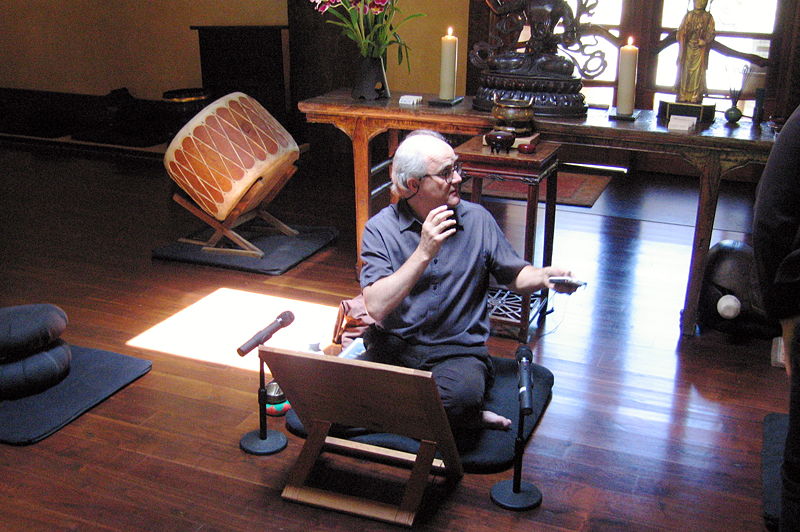
Stephen Batchelor: Deconstructing Buddhism

Via the great audiodharma.org.


Deconstructing Buddhism (Part 1)    03/20/10[Download][Play]1:23:12

Deconstructing Buddhism (Part 2)    03/20/10[Download][Play]34:17

Deconstructing Buddhism (Part 3)    03/20/10[Download][Play]1:30:33

Deconstructing Buddhism (Part 4)    03/20/10[Download][Play]38:54


I recently wrote about Stephen Batchelor's new book, Confession of a Buddhist Atheist. Here are some fresh talks he gave on his US book tour just last week. Looking forward to a listen.

Thursday, 11 March 2010

The new Buddhist atheism (and the old agnosticism)

The Guardian's Mark Vernon has a brief review yesterday of Stephen Batchelor's latest book, "Confession of a Buddhist Atheist."

Vernon notes that the "anti-religion" Christopher Hitchens comes out endorsing this new work, which seems a bit strange after writing in 2007 "of Buddhists as discarding their minds as well as their sandals." Perhaps he's taken the time to look a little more deeply into Buddhism (take note Bill Maher, Brit Hume, etc).

Batchelor, he describes as the "vanguard of attempts to forge an authentically western Buddhism." Having read and enjoyed "Buddhism Without Beliefs: A Contemporary Guide to Awakening" as well as "Living with the Devil" I happily agree with this claim.

Vernon goes on: "For myself, as an agnostic, I was saddened that Batchelor has now definitively opted for atheism: the closure on the transcendent that decision represents felt like a partial turning away from his previous open efforts to discern the nature of things."

Which of course got me thinking, is Buddhism (in the West?) or should it be (anywhere) atheistic or agnostic? A third option, one espoused by one of our fellow Buddho-Bloggers, Adam, is Apatheism. I tend to think that Adam's view most closely hits the mark of the early Buddhist suttas. The Buddha just didn't much care about God (Brahma), Gods (Devas), etc. He taught about them at times, such as how to reach the "Realms of Brahma" by practicing loving-kindness, compassion, sympathetic joy, and equanimity. He even equated this "Realm of Brahma" -if attained by these practices- with "release of the mind" (cetto-vimutti). While traditionally this is felt to be a step shy of awakening (bodhi / nibbana), at least one great contemporary scholar thinks they (tradition) got him (the Buddha) wrong: perfect loving-kindness etc is awakening (see "How Buddhism Began" for details).

But the Buddha also made fun of the Gods, including Brahma, suggesting that he was merely deluded in thinking of himself as the "creator" of all other beings (because he was the first to appear in his realm), and that he didn't have the answers that the Buddha did regarding the ends of the world (universe). But Gods do also play a supporting roll in Buddhism throughout its history. It was a Brahma, Sahampati, that asked the Buddha to teach his Dharma, even though it was so profound that few would understand it. And the Buddha is said to have risen to Tusita heaven to teach his -then deceased- mother.

As one of, I assume, many in the West that came to Buddhism after a period of Atheism (and agnosticism, and anti-theism), I can appreciate the article's discussion of Humanists (oh yea, I was one of those too) flocking to see and read Batchelor's works. As a college student studying Buddhism, one of the most important lessons I received was that Buddhism is more a system of orthopraxis than it is of orthodoxy. What this means is that it is your practice that counts, not your beliefs. To me this suggests that Buddhism is 'big' enough to embrace theists (especially those of a mystical leaning), atheists, agnostics, apatheists, and others without contradiction. So our quarrels about correct understanding of God in relation to the path may be quite mistaken to begin with.

Tuesday, 22 December 2009

Stephen and Martine Batchelor - Godless Religion or Devout Atheism?

Upaya Zen Center is posting an outstanding series of podcasts (14 in all) featuring Stephen and Martine Batchelor speaking on "Godless Religion or Devout Atheism?"

Stephen Batchelor is well-known, and perhaps infamous, for his book Buddhism Without Beliefs: A Contemporary Guide to Awakening. I am a tremendous fan of his modern approach to Buddhist practice. Each new culture that adopts Buddhism has adapted the teachings to make sense within its individual context. In Tibet, the Mahayana became the Vajrayana, which is central to all Tibetan lineages, but not identical with Tibetan Buddhism [Al Billings made an important correction on this point in the comments, for which I am grateful]; when Bodhidharma went to China, the teachings became the Ch'an tradition; in Japan, the Ch'an teachings became Zen.

We are now 2,500 years removed from the Buddha's enlightenment. The values and structures of human awareness have changed considerably since then. We are now more rational and less superstitious, so it is appropriate the Buddhist practice evolves to reflect who we are now as students. Progressive Buddhism, from my perspective, acknowledges the profound technology of enlightenment that the Buddha has left for us, but we also acknowledge that the cultural context of the original teachings are no longer appropriate to our current cultural context.

Perhaps unique among the current Buddhist teachers, Stephen Batchelor is offering us a progressive form of Buddhist practice. Enjoy the podcasts - I will post two more groups of five as they become available in the coming days.

Listen to the “Godless Religion or Devout Atheism?” series

For the next 10 days from Dec 18 to Dec 27, we will be sequentially releasing the podcasts from the Godless Religion or Devout Atheism? series recorded in October.

* * * * *

Godless Religion or Devout Atheism? Part 1 of 14 – Session 1

Speakers: Stephen and Martine Batchelor

Stephen opens the retreat asking, “What is Buddhism?” Is it devout atheism or a godless religion? Over the next few days, we will individually look at what the practice means to us. The West has begun to look at the different Buddhist traditions and scriptures in a way that has never happened before. We are fortunate in that we have a huge amount of information available to us. Martine discusses the practical set-up of the retreats, and sets the objectives for the meditations.

Podcast: Play in new window [Play] [Play] [Play] | Download [Play] [Play] [Play]

Godless Religion or Devout Atheism? Part 2 of 14 – Session 2

Speaker: Stephen Batchelor

Stephen deconstructs what we know of Buddhism, offering interpretations and explaining cultural elements of Buddhism that came from the Buddha’s time. This reveals what is left of the Buddha’s original teaching. In original texts, the Eightfold Path ends with the Four Noble Truths, which in turn end in the Eightfold Path. Stephen discusses what society was like at the Buddha’s time and what most people knew about other cultures, histories, and ideas. Therefore, we must rethink the Four Noble Truths and perhaps unlearn what we have been taught about Buddhism.

Podcast: Play in new window [Play] [Play] [Play] | Download [Play] [Play] [Play]

Godless Religion or Devout Atheism? Part 3 of 14 – Discussion and Q & A

Speakers: Stephen & Martine Batchelor

Topics include the myth of the Buddha vs. what we know to be more certain; the Buddha’s vision of society; unpacking the myth of the Buddha as a real man; the origin of merit in Buddhism.

Podcast: Play in new window [Play] [Play] [Play] | Download [Play] [Play] [Play]

Godless Religion or Devout Atheism? Part 4 of 14 – Dharma Talk on Exploring Meditation

Speaker: Martine Batchelor

In Zen generally there are 2 types of meditation: samatha and vipassana, or concentration and open awareness. However, in practicing samatha, we do not concentrate to the exclusion of everything else. In vipassana, we can use the brightness of the mind to inquire, as looking deeply is what causes transformation. Through samatha and vipassana, we experience the diminution of habits.

Podcast: Play in new window [Play] [Play] [Play] | Download [Play] [Play] [Play]

Tags: , , , , , , , ,

Friday, 5 June 2009

Atheism asks "What's wrong with dualistic thought?"

I try to make it a habit to not critique or criticize others ideas or beliefs from other posts, as I've had it done to me a few times and is rather irritating and sad. However I felt compelled to point out this rather interesting post I found on about.com entitled 'What's wrong with Buddhism?'. Austin Cline, the author and self confessed Atheist, asserts a lot of connections between Buddhism and other religions. Most of the post is spent quoting another source , but somehow he took away from this other persons first hand experience, with what was obviously some cult or dogmatic thing, to be true for everyone who calls themselves Buddhist.

"Although Buddhism seems so different from religions like Christianity and Islam that it doesn't look like it should be in the same category, it still shares with other religions a very basic element: a belief that the universe is in some fashion set up for our sake — or at least set up in a manner conducive to our needs. In Christianity this is more obvious with the belief in a god that supposedly created the universe for our benefit. In Buddhism, it is expressed in the belief that there are cosmic laws that exist solely to process our "karma" and make it possible for us to "advance" in some fashion"

Ummm, ok? I don't understand why he, and many others, try to pigeon-hole all Buddhists, or better yet all people into little different boxes, wrap them up with neat little bows and then proclaim them all wrong, without first seeing or exploring for themselves. I have quite a few self professed atheist friends, including my brother, who are open to the notion that maybe the world isn't black or white, who understand you can't always define every little aspect of reality and who want to see for themselves rather than relying on what someone else says for truth. I greatly admire and respect this trait in those that claim themselves to be Atheist or Agnostic. God or no God, this is the blunder, to think we rely on belief or some holy word or any other extreme view to seek or know truth.

"Although it's more of a problem in some and less of a problem in others, it's still a fairly consistent problem that people are falsely taught that there is something in or above the universe that has picked them out for special protection and consideration."

True enough for most religions, but who told you modern Buddhists are taught this or believe this? If you really think progressive Buddhists think they are picked for some special purpose, then dare I say, you didn't ask any progressive Buddhists? Hell, I may go even as far to say you have a strong opinion about religion itself, as do I, and fit your ideas to match this opinion.

"Our existence is a product of luck, not divine intervention, and any improvements we achieve will be due to our own hard work, not cosmic process or karma."

First off, Luck? Really, luck? Cause God and luck are about the same to me, both words with no real meaning, extreme views on opposite ends of the spectrum. If you believe in luck, why not just believe in a random God, they are both still some belief to be beholden too. Maybe, if you took some time to understand the nature of 'self' you would see ultimately our 'existence' is a product of our own minds. Karma is nothing more than action or cause and effect or as the Buddha said part and parcel to dependant arising. This means we do not exist in a vacuum, but are connected to everything else that is. Time is illusory, and to think things exist as separate objects is the same as the extreme belief of creation or nihilism or non-existence.

"People can try to eliminate these aspects of Buddhism, but they are likely to eliminate so much that it's hard to call the leftover very Buddhist."

You are absolutely correct, I am not a Buddhist; but at the same time I am a Buddhist. If you can see for yourself some truth or logic in this paradox, you will see why we find what is 'left over' to be so valuable.

Sunday, 14 December 2008

Society Without God: a review

(note: this is quite a bit more lengthy than a typical blog post)

Abstract:
In today’s rapidly evolving religious climate, few studies have been made of secularity in the modern world. Phil Zuckerman, a sociologist from California, brings us Society Without God: What the Least Religious Nations Can Tell Us about Contentment to help fill that void. It is an ambitious project, blending personal stories and sociological data gathering, as well as historical, political and theological insights. For those of us in America who can feel that our country is a bit (religiously) strange, but can’t quite put our finger on how and why, this is the perfect book. It is, indeed, an apology for secularism, showing how it is woven into the wonderful societies of Denmark and Sweden. For readers of Progressive Buddhism, we find questions of “Cultural Religion,” discussions of issues such as belonging vs. believing, and perhaps some hints at where we as individuals as well as Buddhism as a whole will fit in to the above-mentioned rapidly changing religious climate.
~
There have been two noteworthy trends in our society of late. The first is the rise in somewhat hokey movies (Signs, Henry Pool is Here) and some not-so-hokey ones (The Passion of the Christ) trying to convince us of the existence of God or miracles. And the second is the recent boom in psychology, popular writing, and even philosophy, trying to describe and teach us the so-called science of happiness, the art of happiness, or (one of my favorites) the accident of Stumbling on Happiness.

It has become commonplace in America to equate religiosity with happiness, with some even pointing to social and sociological studies suggesting the greater contentment of believers. Atheists (and often Buddhists by implication), now as much as ever, have quite a challenge in modern American society. In one scene in Henry Pool is Here, a movie I only watched because it was shown on a plane, two of Henry’s nosy neighbors are talking about him and one says (I paraphrase), “he seems so unhappy,” to which the other replies, “well, no wonder, he is an atheist.”

It is perfectly acceptable or perhaps even common sense, it seems, to connect atheism and unhappiness. As a Buddhist (and atheistic), this is not only ignorant, but offensive. It is an assumption based only on prejudice. What if they had observed instead that he seems angry: “well, no wonder, he is a Muslim” or wealthy: “well, no wonder, he is a Jew.”? Attacks on atheists seem to slip through the cracks in our society, perhaps simply because they are so widespread. Indeed, Zuckerman recounts the vitriol spewed by a half-dozen media pundits and religious leaders from Bill O’Reilly to Pat Robertson (pp. 19-20). All make similar and patently false statements regarding the demise of any society lacking a robust faith in God.

Religion, and by that I mean mostly the Religious Right, has exerted itself mightily in the last twenty years in America despite, scandals and abuses. And whether it is a science, an art, or an accident, happiness is a hot topic these days. It is into this melting pot that Phil Zuckerman throws his latest work: Society Without God: What the Least Religious Nations Can Tell Us about Contentment. In this book Zuckerman takes us to Denmark and Sweden, two countries that seem today to be less religious than ever (p.2).

It’s a difficult book to classify. It is the work of a trained sociologist and thus carries the mark of that discipline: interviews, data, statistics, and the analytical tools needed to make sense of it all. But it is also something of a travel-log by an intelligent atheistic American in an amazing society that, as he points out, so many Americans would not – could not – believe exists. As he says in the end of chapter 2, after describing an idyllic bus ride through a major city in Denmark, “So many Americans assume that without strict obedience to biblical laws, society would be chaotic and horrific. If only they could take this ride with me, I thought to myself” (p.31).

The third genre is something of a socio-religious biography of the people, 149 formal interviews with adult Scandinavians of all ages, education levels, and jobs. The sample, while large and in some ways random, did have a ‘convenience’ factor (meaning Zuckerman interviewed people who were readily available and even sought some out based on interesting conversations or their occupation) so it shouldn’t be misconstrued as representing the entire Scandinavian population. (see note 1 at bottom) It is in these interviews that one gets the best feel for Scandinavian life and thought, as you hear the views of so many ‘average’ people. These interviews reveal a richness of life in family, friendships, and social responsibilities all without a faith in God.

The very existence of the people in these interviews and their stories would not be remarkable, Zuckerman points out, if they were the exception to the rule in Scandinavia. In fact, atheists are the norm. Their existence and the flourishing of these “Godless” societies should put an end not only about the vitriol of the Pat Robertsons of the world, but also those who attempt to show by science that we are ‘hard wired’ for faith in God (cf. pp.55-56). If only it were so simple.

Interestingly, in interview after interview the Scandinavians speak of their society as being based on the ethics of the Bible, following ideals of kindness to others, honesty, and so forth. To them it seems that it is these teachings that are important, not the belief in God, heaven, or hell – not to mention biblically motivated anti-Semitism, discrimination of homosexuals, or denial of women’s reproductive rights. And Scandinavian society reflects just this: higher openness, a welfare state (based on the belief that free education and healthcare benefits everyone), strong community relations, the virtual eradication of poverty, and so on. Many of these same interviewees hypothesize that in past generations, when belief in God was far more prominent, the reason was precisely the lack of equity and stability in society. As life became better, as the society became more socialist (to use an overly and unduly harangued term), the need for religious belief simply fell away.

Further into his analysis, Zuckerman covers this very idea in his discussion of Why? (chapter 6). Several theories are presented, including the idea that “Secure Societies” are more likely to be irreligious. Other theories suggest that “Lazy Monopolies” – in this case the Lutheran church – lead to decline or that “Working Women” no longer keep their husbands and children in the churches. What we find is that while some theories match up remarkably well in Sweden and Denmark (all three of these, in fact), it is impossible to pin the cause of secularism on any one of them. Each also faces counterexamples elsewhere in the world.

Society Without God includes a history of religion in these countries, attempting, albeit very cautiously, to discern the religiosity of these people over the last 1000 or so years. We also find a discussion of what it means to be a Christian (chapter 8). Reflecting on his own (very secular) Jewish upbringing, Zuckerman suggests that Scandinavian Christians are similarly “culturally” religious while personally atheistic or agnostic. As Christmas draws near I wonder how many of us (Buddhists and otherwise) might consider ourselves "culturally Christian." Most of us will do something on Christmas, even if it is simply spending a little extra time with family. And if we put up a tree, exchange gifts, put up lights, and God (ahem, I mean Buddha) help us, sing Christmas songs together, then we are “participating in something ostensibly religious, without actually believing its supernatural elements” (p.155). Ergo we are being culturally Christian.

Zuckerman concludes his study with thoughts from back in the US. Within hours of his return, he finds himself in the house of a born-again Christian showing off his “new toy” (a handgun). Ahh, how things change. Then, at a bank, he overhears an employee advising a debt-ridden patron to see a pastor to pray over the indebted person’s bills, give $50 a month to his ministry, and trust that “within a year, God will see to it that your debt is all gone” (p.167). Traveling from a land where God is practically obsolete to trusting Him with your personal debt must have been quite a shock. It was also traveling from a land of general contentment, good health, and security to a country with only moderate life-satisfaction, a perilous (despite being technologically spectacular) health-care system and depressingly high rates of violence.

If one could criticize the book, it would be on the grounds that it is too ambitious. In trying to tell so many stories in under two hundred pages, Zuckerman stretches the bounds of his own expertise and potentially the patience of his readers. Despite its core of sociological data-collecting, it is clear that the book is in fact an extended musing on the fairly personal topic of religion by a young and talented scholar. Yet it is difficult to imagine the book being anything other than what it is. Cut out the interviews and history and it loses its punch, remove the personal stories and ties to politics and contentment and it loses its emotive appeal. This reader was both very satisfied in this book, seeing much more clearly that (in the US) it needn’t be this way - we can be happy and safe without faith in God, and at the same time I left yearning for more.

1) Zuckerman goes over his methodology in a brief appendix.

Monday, 29 September 2008

The Face of God (Part 1 of 2)

Personally, I've never had a belief in God, and tended to believe that the Abrahamic (why do people say 'Judeo-Christian' and exclude Islam?) concept of God and 'His' supposed purposes were incoherent. That doesn't mean that I didn't have a strong sense of 'spirituality', it just means that I didn't attach it to a concept of an anthropomorphic creator being. It was nature/existence itself that awed me.

Some Zen teachers occasionally talk in terms of 'God' - even the iconoclastic Brad Warner sometimes does. The word is being used as a way of expressing a Buddhist idea in 'Western' terms. However, the concept used here is far from the Abrahamic concept of a separate, self-existent, supernatural and (always to at least some extent) anthropomorphic creator used by most theists. Personally I tend to think that it should be avoided to prevent confusion.

There are some people - mainly Christian-Buddhist hybrids (not sure how that works) and Christians looking for common ground who try very hard to show that Buddhism and Christianity are essentially saying the same thing. I think that ultimately there may be an element of truth in this, but I think that a great deal of damage is done to a concept such as Sunyata (emptiness) by trying to squeeze it into a God-shaped hole. I tend to think that the concept of God is, in part, derived from experiences of 'no-self' and 'oneness', interpreted as a cosmic event - a union between a discreet self (individual soul) and a discreet Absolute (Godhead). This is naive and simplistic compared with the subtlety and sophistication of Nagarjuna's concept of Sunyata and Dogen's (and others') descriptions of the relationship between relative and absolute. In Buddhism, the denial of a separate self (anatman) and a separate absolute (nirvana) are key concepts. The rest as far as I can tell is a naive search for explanations which will fit into our common-sense conceptual structure on the basis of faulty logic and blind faith.

Even putting aside all the issues of evidence and the validity of 'personal revelation', and all the problems of Biblical literalism, I find the concept incoherent. Here is a small selection of the questions I think the idea of God begs:

Why would an omniscient, omnipotent, omnibenevolent being use methods of improving his creations, which required great suffering, (existence, freewill, evil, evolution) with no sign of resulting improvement?

Why would a perfect being need to create humanity let alone need its love?

Events/changes require time to occur in, so how could the creation of space-time occur before there was any time for it occur?

The usual answer to these sorts of questions is some variant of 'God works in mysterious ways', but this comes back to How do you know He works in mysterious ways?, How do you know the Bible is infallibly true?, How do you know that God exists?, How do you know (enough to make claims about it) what God is like?. Blind faith - a personal feeling of conviction isn't valid, as demonstrated by the number of people who have absolute faith in their beliefs and yet who contradict each other or who are demonstrably false and/or insane. Faith in Buddhist practice, as I understand it, is of a more ordinary sort - like the faith of a climber in his ropes. The 'intuitive knowing' described about 'enlightened masters' is something else - 'knowing' is not quite the right word and it is not knowledge of anything supernatural or metaphysical - rather, it is just being fully attentive to reality, absent of certain illusions we have about it.

I find it interesting that the less literal the interpretation of Biblical and traditional explanations of God are - the more 'ineffable' they are, the less problematic they become, because such claims are less concrete. Instead of the jealous tribal god Yahweh who lives on Mount Sinai and smites the enemies of Israel, God becomes a cosmic source or principle beyond space and time, almost equivalent to the deepest laws of physics. A consequence of this is that the more anthropomorphic supposed 'purposes' of this entity start to become absurd. 'God is the unknowable source, the will of nature, the very ground of all being...and He hates gays.'

If God is a synonym for the deepest principles of physics, what word is left for a hypothetical being who answers prayers, intervenes to save cancer patients or helps evolution over difficult jumps, forgives sins or dies for them?
Richard Dawkins

I came across this excerpt and really enjoyed it. I know that 'Zen talk' can seem pretty bizzare so I've added my interpretations of what Seung Sahn said.

After one of the Dharma Teachers was finished with his introductory remarks, he asked those congregated to direct their questions to Zen Master Seung Sahn, Soen Sa Nim. One of the visitors asked if there was a God.

Soen Sa answered "If you think God, you have God, if you do not think God, you do not have God."
[God and the absence of God are mental constructs]

"I think that there is no God. Why do I have God if I think God?"

"Do you understand God?"

"No, I don't know."

"Do you understand yourself?"

"I don't know."

"You do not understand God. You do not understand yourself. How would you even know if there was a God or not?"

"Then, is there a God?"

"God is not God, no God is God."
[Apart from our mental contruction there is inherently no God or absence of God. Alternatively - the Ultimate (God) and nothingness/absence of inherent nature/interdependence are the same. ]

"Why is God not God?"

Holding up the Zen stick, Soen Sa said "This is a stick, but it is not a stick. Originally, there is no stick. It is the same with God for originally there is no God. God is only name. The same is true of all things in the universe."
[Conventionally sticks exist, but ultimately they do not, for their nature is dependent. The same is true for God.]

"Then is there no God?"

"The philosopher Descartes said, 'I think therefore I am.' If you do not think, you are not, and so the universe and you are one. This is your substance, the universe's substance, and God's substance. It has no name and no form. You are God, God is you. This is the 'big I,' this is the path, this is the truth. Do you now understand God?"
[All things (including 'God' and 'no God') are ultimately of one substance. Is this God? It cannot be named.]

"Yes, I think that there is no God, and I have no God."

"If you say that you have no God, I will hit you thirty times. If you say that you do, I will still hit you thirty times."
[By saying there is or there is not a God, the visitor is trapped by thought and language and unable to apprehend reality as it is before conceptual thought distorts it. Reality is not found at either of these extremes but in a non-conceptual 'Middle Road' between them. The threat of violence is just gentle encouragement.]

"Why will you hit me? I don't understand. Please explain."

"I do not give acupuncture to a dead cow. Today is Tuesday." replied Soen Sa.
[This is a waste of time. Forget all that abstract stuff - this is reality].


I just found this short little piece, which I also like:

Zen Master (to student): Do you know God?
Student: I don't know
ZM, Do you know Buddha?
Stu, I don't know
ZM, Do you hear the waterfall?
Stu, Yes
ZM, Just That.
[Forget your ideas about God or Buddha - the sound of the waterfall is the real 'God'/'Buddha' ie. ultimate reality, not some idea about something transcendent but reality itself]


This was originally published in my personal blog in 2006.
Photo courtesy of Reverend Brendan Powell Smith